Army food service tests autonomous dining facility and automated cooking in Korea

The U.S. Army opened its first autonomous dining facility in Korea in November, launching a six-month pilot to test how robotic technology can improve food service operations and soldier readiness.
The facility, called Market 19, operates inside the Camp Walker dining facility and pairs self-service kiosks for ordering with automated cooking and serving systems. Army culinary specialists and contracted staff oversee the automated systems and ensure that the same nutrition and safety standards as in traditional dining facilities are met.

The pilot is designed to evaluate how self-service ordering and automated cooking systems can make Army dining operations more consistent, efficient and resilient, said Chief Warrant Officer River Mitchell, food advisor for the 19th Expeditionary Sustainment Command. The effort is not intended to replace people, he said, but to expand the Army’s ability to feed soldiers “anytime, anywhere” while maintaining standards for quality and safety.
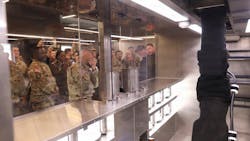
The autonomous kitchen uses robotic cooking modules programmed to prepare meals from fresh ingredients, using standard Army recipes. Soldiers and civilians order menu items on a touchscreen interface, and the system automatically portions, cooks and plates each order. During the self-serve ordering process, each meal’s nutritional information is updated based on the diner’s choices.
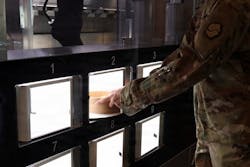
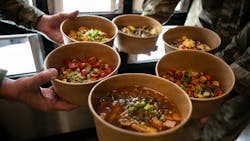
Menu options are designed to optimize performance and to align with Army nutrition guidelines. They include Korean favorites such as bibimbap, kimchi fried rice and budae jjigae (or “army base stew”). All ingredients are sourced through the Defense Logistics Agency Troop Support supply chain and the Army food catalog to ensure the automated facility maintains the same nutrition and safety standards as traditional dining facilities.
Mitchell emphasized that human oversight remains central to the pilot program. For instance, Army culinary specialists manage food safety, ingredient preparation and quality control. They also provide nutritional education and prepare additional food options to supplement the automated line. Culinary specialists who prepare recipes and ingredients for the autonomous system have been trained by both the Army and local national chefs.

The pilot is intended to add capacity and consistency to food service operations without reducing the existing workforce. By offloading repetitive cooking tasks to the robotic system, culinary specialists will have more time to focus on readiness training and improving overall meal quality, Mitchell noted. He added that automation is one way the Army can modernize dining operations while preserving the “human touch” provided by trained culinary professionals.
Throughout the six-month trial, soldiers and contracted staff will jointly evaluate the autonomous kitchen’s performance, reliability and impact on dining operations. The data collected will help determine whether and how to expand autonomous dining capabilities to other locations.
Why this matters
- The autonomous dining and self-serve pilot program demonstrates how robotics and self-service technology may move from commercial food service into military sustainment operations. Moreover, experimentation with autonomous dining technology provides insights into rescaling such approaches for commercial applications such as breakroom refreshment services.
- The pilot reflects a broader trend toward on-demand access to meals that mirrors the always-on expectations seen in convenience services and micro market environments.
- Integrating nutritional data and performance-focused menus into an automated platform aligns with growing demand for health-driven, data-informed food choices.
- As large institutional buyers test autonomous food service, convenience and refreshment providers may see rising expectations for speed, customization and 24/7 availability.
The appearance of U.S. Department of Defense (DoW) visual information does not imply or constitute DoW endorsement.
About the Author

Linda Becker
Editor-in-Chief
Linda Becker is editor-in-chief of Automatic Merchandiser and VendingMarketWatch.com. She has more than 20 years of experience in B2B publishing, writing, editing and producing content for magazines, websites, webinars, podcasts, newsletters and eBooks, primarily for manufacturing and process engineering audiences. Since joining Automatic Merchandiser and VendingMarketWatch.com, Linda has developed a new appreciation for the convenience services industry and the essential role it plays. She is dedicated to serving readers by covering the latest news in the vending, office coffee service and micro market industry. She can be reached at 262-203-9924 or [email protected].