Tom Bauer unlocks the formula for operational efficiency in 2026
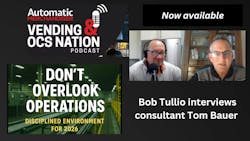



On this episode of Automatic Merchandiser's Vending & OCS Nation, Tom Bauer sits down with podcast host Bob Tullio to reveal five essential focus areas to help your business thrive in 2026. From logistics to route optimization, these tips don’t require big investments — just your time and dedication.
The podcast emphasizes the importance of not overlooking operations and creating a disciplined environment and culture. It highlights the need for changes in 2026, focusing on disciplined people, thoughts and actions to improve organizational efficiency.
Get more operations advice from Tom Bauer
 5 ways convenience services operators can improve efficiency
Listen to the podcast to learn more about Tom’s perspective on five key things to pay attention to:
- Logistics
- Warehouse efficiency
- Route optimization
- Fleet and vehicles
- Service tech efficiency
Optimizing these operational areas will deliver benefits such as:
- Cost reductions
- Faster delivery
- Scalability
- Enhanced customer satisfaction
No time to listen? Prefer to read? Here is an edited podcast transcript:
Bob Tullio: In this episode of Vending & OCS Nation, it is a conversation with Tom Bauer, The focus is on operations, and he is well qualified to talk about it. I asked Tom to outline his industry journey.
Tom Bauer: I look back at where I actually started, which was at Pepsi-Cola years ago, getting out of college, jumped on a route truck and learned this business from the ground up. To this day, I look back at those days and the about three years that I was at Pepsi-Cola. And what I learned out there on the route, dealing both with what we called back then the on-premise business, a lot of that is OCS, and then also the retail side.
You fast-forward, I was fortunate to be able to continue to grow in my career with different organizations. So from Pepsi was at Anheuser-Busch as a franchise operator there in Louisiana. Then I got into the coffee industry with a great company, Community Coffee. Had an opportunity to help with their expansion. At the time, they were just on the retail side, had a lot of business in southern Louisiana. So then from there, went national with a company called Standard Coffee and had an opportunity to work in the divisions of Standard Coffee. And then from there, I had an opportunity to go to Farmer Brothers Coffee and that kind of takes us up to today. And I was the chief operating officer and chief commercial officer there, as well as overseeing the sales, operations, logistics, customer service, marketing — all the different functions that fall into those areas of those responsibilities of those positions.
Got into consulting now. So that’s what takes us up to today, Bob, is I’ve been doing some consulting work within the industry and have learned a lot over the years in all those areas that I just mentioned, all the great companies I was with, and it’s been a great journey.
Bob Tullio: Tom, my focus is always on business development, and I know you do plenty there, but I really wanted to have you on the show to talk about something that you think about a lot, you’ve had to deal with a lot, and that’s operational efficiency. And this time of year, I always like to say, all right, let’s look forward. What are the tips that you have for operators of the convenience services industry to improve their operational efficiency in 2026?
Tom Bauer: Many times we talk a lot about sales, and that’s a key ingredient, obviously, to any organization. But when it comes to operations, that’s a key component that we’ve got to keep an eye on. So one of the things that I’ve been preaching, if you will, and educating and training some of our organizations on are five key areas, I would say.
And you know, most of these don't really require huge financial investments, or in some cases, any investments at all, but really require just some time, some diligence, and what I'll call consistency, and keeping your eye on the ball and staying focused on these.
I’m going to cover five areas that I think are important. Pay attention to these five areas. When it comes to company operations, you’re going to see results, I believe, and cost reduction. In many cases, you’re going to see improved delivery speed. You’re also going to see scalability, the opportunity to really scale the operation. And then the fourth, I think, key area that is improved is the enhanced customer satisfaction. And ultimately, in this business, we’ve got to be able to provide the best customer service available. And that, in many cases, is going to differentiate us from the competition.
So that’s where I’d like to kind of go today: to talk about these five areas. Number one would be logistics. We'll get into then number two, some warehouse efficiency. Third area will be route optimization. Then we'll talk about fleet and vehicles. And then fifth will be kind of service tech efficiency.
So, operations can cover a lot of different areas. If you happen to be with a company that’s a roaster or a manufacturer, operations, obviously, production is going to fall into operations. I’m not going to get into that today. Again, I’m trying to keep it short and sweet as far as five areas that I think can be very impactful as everyone goes into 2026. And these tips will hopefully help everybody as they go into 2026, with goal setting and taking a look at some of these areas that sometimes we focus on, other times we just kind of let them run as is. And I think if we’re doing that, then we’re doing ourselves a disservice by not really taking advantage of some of the cost efficiencies and other things that I mentioned there.
Bob Tullio: There’s so many new operators out there that will be hanging on your every word. And as you say, for veteran operators, even when I give a presentation, or when you give a presentation on sales, you hear people say, it’s nice to get a reminder. So let's start with logistics.
Tom Bauer: When I say logistics, I just want to kind of define what that means. What I’ll be talking about here is really from the manufacturer or supplier to your DC or to your branch. Okay, so within that, there is the, what I'll call the TMS, the Transportation Management System. You know, this really acts as kind of a control tower, if you will, for freight operations. And it does include planning, it includes execution, and it includes optimization. So the TMS, the Transportation Management System, is part of logistics.
Now, there's some key features that I'll say within this that come to mind. One is kind of the routing or the mapping optimization and carrier selection, right? So, how is it getting from point A to point B? And if I don't have my own internal vehicles, what's the carrier selection process that I'm going through? And again... There's software out there that allows companies to kind of plug and play, and it will help them along the way.
Where is the shipment? When is it going to be to the DC or the branch? Because we got customers that are waiting in some cases on that product.
So again, that's part of the TMS. Also the TMS, again, transportation management system will allow, you know, for freight auditing and invoicing, which is critical. So that's a component of this programming this software.
And then the fourth area within the TMS is going to be the integration capability that it would have with any company's ERP system. And also with your warehouse management system, which I'll talk about here in a second. So again, logistics — point one — TMS, the transportation management system, have that in place. There's software you can buy off the shelf and you can utilize those platforms.
Bob Tullio: So very simply, what you recommend to operators then is to Google TMS software and take a look at what's out there and find what's right for you.
Tom Bauer: Absolutely. And that's going to be the key. What's right for you? You know, we've got small, medium, and large operators that are out there. Everyone's going to have a different need. And absolutely go out there. You can Google it. They can find plenty of platforms and software that's available and really work with what's going to be best for them.
Bob Tullio: Let's talk about warehouse efficiency.
Tom Bauer: So within warehouse efficiency, there's going to be three points I want to make here.
First is going to be your warehouse management system. So similar to the transportation management system, you want to have in place a warehouse management system. This is going to optimize your warehouse operations overall. And this is going to include inventory tracking, order picking, packing, and shipping. So with this WMS system, and again, you can get things off the shelf, you can Google it, you can find out based on what your business platform is, what's going to work best for you.
Number two is going to be really controlling the inventory then within your warehouse efficiency. And that's going to be the inventory management software that you're going to be able to find and again, focus that on what your needs are. You know, you really want to track your stock levels. There's nothing worse, as we all know, than being too heavy or running out. If we're running out, we're losing sales. If we're too heavy, it's like dollar bills hanging, you know, in the rafters there in the warehouse. And so it's going to be critical that we're focusing on proper stock levels.
With this kind of a system, it's going to allow you the flexibility to have some automated reordering. And it's also going to be integrating into your accounting or e-commerce platforms as well. So it's very flexible. It's going to allow you to integrate it within your existing systems. But most importantly, it's going to allow you to really track and keep an eye on your inventory so that you have the right inventories at the right time and in the right place. If you've got multiple branches, a couple of DCs, depending on the size of the company, having the right product in the right place at the right time is really so critical.
The third area is going to be what I'd like to talk about as far as route optimization. So route optimization can cover a lot of areas. If companies don't have the software, it's easily accessible out there. You want to have something in place because — depending on if you have four routes or 30 routes or 130 — you really want to make sure that those routes are optimized. I used an in-house, custom-built program when I was at Farmer Brothers, but it worked well, right, for us and what we needed. But again, a lot of options out there, a lot of software that you can buy off the shelf.
First and foremost, dynamic routing. With a software program like this, you're going to ensure that you're going to have overall efficiencies with your routes. You know, how many stops are they making per day? What's the cost per stop? Those are all critical KPIs when you think about it to making sure that you're going to be profitable and depending on how many routes out there, you can multiply that and you're either going to save a lot of money or you're going to waste a lot of money.
Are we there on time when the customer expects us to be there and are we running that route efficiently? The route sales drivers — some people call them drivers, some people call them route sales representatives — they must meet specific delivery windows for each account. And the data will will show that.
I was talking to an operator just this past week, and they're a little bit behind as far as software implementation, don't have a lot of visibility on what the routes are doing day in and day out. And that's a high risk for that individual. As an owner of an operation, he's really depending on people to be trustworthy and to make sure that they're accurate.
There's human error that comes into play. They might not be doing something intentional, but all of a sudden, there could be an issue with some of the inventory levels that are out there. And so this kind of a program, the route optimization, will help you know and understand exactly where the routes are and what they're delivering and how much they're delivering.
If we're efficient, guess what? We're going to reduce our overall fuel costs. If we're efficient, we're going to have less idle time that's out there as well. All of those add up and make you more efficient as an operator. Route optimization is huge.
There's a few emerging trends that I want to mention real quick, Bob, within the route optimization. You know, AI-powered optimization now is coming into focus. So, you know, there are some very dynamic rerouting programs through AI that are going to really take a look at what's happening with the traffic flow right now in a certain city. So I would just empower everybody to look at the options that are out there when it comes to AI and what is happening there. It could enhance the overall route optimization when it comes to traffic and/or even weather.
There's what they call a mobile-first platform. So, you know, for real-time driver updates and proof of delivery, that's becoming larger and larger. Integration with your ERP and, as I mentioned, your WMS systems, for end-to-end visibility is going to be available.
And then cloud-based scalability for peak demand periods and growth. Those are emerging trends when it comes to route optimization.
There's a lot of us that, you know, you think back in the day and you were doing your route optimization maybe with pen and paper. Today, you have the ability to get something off the shelf, relatively inexpensive, that can maximize the overall efficiencies of the operation for the operator themselves.
One piece that I'd like to mention in here too, Bob, is within route optimization is what I call route profitability. Now this ties in a little bit to sales. But I still look at it as an operations piece when you're talking about the profitability of a route.
It begins with account profitability: You're looking at your product gross margin, your asset expense, your delivery expense. So a lot of components that are included in this, but you want to establish targets and goals, by account, to improve the overall profitability.
So if your routes are efficient and you're optimizing your routes, now every time you're stopping the truck, you want to make sure what? That you've got profitability coming from that account and the overall route then is going to be profitable. Some of the areas that everybody that's probably listening to this knows, you got to increase price appropriately. We have just gone through some large swings with the C market and, you know, everybody took price increases, but you got to keep an eye on that. So increase prices appropriately.
What's the product mix within that account? What's the asset allocation? Are we over-equipped with our brewers or not? What's the delivery frequency? Am I going to an account once a week, every other week or once a month? And then, should I even be stopping a truck there? Or is there a different delivery method, such as what I'll call a pick, pack and ship.
So, within that route optimization, we want to make sure that the routes are profitable. The routes are going to be profitable if the accounts aren't profitable, so you got to really take it down to that level and measure all of those areas of the business on a regular basis, whether it's monthly or it's quarterly, but you can't go an entire year without really measuring some of those areas.
Bob Tullio: Let me ask you a question. I mean, from what you see out there with operators, especially the mid-sized operator, and that's a tough place to be when you're in that mid-sized and so many operators are there. You're growing, you're trying to put systems in place. What's the biggest area of deficiency between logistics, warehouse efficiency and route optimization? Where's the greatest deficiency that you see out there? What do you think they should focus on first?
Tom Bauer: When you're looking at the appropriate inventory, I think right now that's been a real struggle for a lot of organizations. And I don't want to blame it all on the C market, but that has caused some of the shortfalls when it comes to inventory levels at the warehouse, at the DC, at the branches. The route sales representative is leaving from the branch without all of the products that they'd like to have. So, I think recently that has been one that I've heard a lot about as far as just not having products in inventory for a couple of reasons.
One is the C market, but then when you look at some of the allied items, it's trying to keep costs down, trying to do the just-in-time inventory. So that's a tough balancing act that I think the mid-tier operator is continually having to deal with.
The other piece too is that often just let the routes run. They load up in the morning, they take off, and they come back, and we're really not keeping a close eye on how efficient those routes are. Yeah, maybe they hit 10 stops today, but how much did they drive? Maybe they only hit three stops today, and they came in early. You know, what else were they doing throughout the day? Did they have an opportunity to do some cold calling and try to drum up some new business?
So, you know, the route optimization piece is right up there with some of the struggles that many operators are having to make sure that those routes are as efficient as possible. And that's something that takes diligence on the part of the management and the leadership team to continually focus on “How are my routes running each and every day?” and make sure that they have the metrics to be able to measure exactly what's transpiring. with those routes on a daily basis. I would say those are a couple of the big ones that I've heard really over the last few months in particular, Bob.
Bob Tullio: Talk to me about the fleet and vehicles and how that affects the operational efficiency of a business.
Tom Bauer: Yeah, and again, I look at this as one of those that, again, we tend to just kind of let it roll from year to year. We've got our fleet, the trucks are rolling, and every once in a while, they need some maintenance. But this is one of those where I think it's essential to plan accordingly.
And as the dynamics of the business change and the routes change, you have to then, I think, change vehicles potentially as well. So, one of the things that sticks out for me on this is “Do we have the right vehicles for each route?”
Some operators are switching from a traditional, what I'll call delivery system, DSD system, to maybe a pre-sale system. You know, micro markets are huge now, so you've got your micro market routes. Is it a rural route? Is it an urban route? Is it a hybrid of the two? You know, what's the product mix that we're carrying on the trucks? And are we being as efficient as we can with the pack out on those trucks?
So I would challenge everybody to continue to look at their fleet and ensure that you've got the right vehicle for the right route and plan ahead when it comes to leasing or owning the vehicles as well.
There's a lot of advantages to leasing vehicles these days as opposed to owning them. At the same time, you've got to plan ahead when it comes to the replacement schedule. If your fleet is getting up there in years, don't wait until it's breaking down and then, all of a sudden, you've got to replace a transmission to make the decision that you need a new vehicle because now it's going to cost you potentially more than if you'd planned ahead of time. and either put that in the budget or work something out with a dealer, letting them know that you need three or four vehicles in the next year or two. So, you know, when it comes to the maintenance schedule, that's a big one as well.
Every time a route sales representative leaves, somebody should be checking that vehicle as far as going through the maintenance check and checking off the boxes, tires are good, open it up, oil's good. Believe it or not, those are the basics that have to get done every single day — we’ve got to make sure that we've got that maintenance schedule intact. Again, you can save a lot of time, money, fuel costs, maintenance costs, etc. If you just spend a little focus on that, a little time on that on a monthly basis, but for sure on a daily basis, the people that are taking those vehicles out got to keep a close eye on them and should be doing that pre- and post-trip check.
Bob Tullio: Well, you know, you're bringing back some memories for me as an operator. I remember my operations partner, Larry Deegan. My Lord, this guy spent so much time on vehicles because it is a day-to-day thing. When you get to about 40 vehicles, you get to a point where you've got breakdowns, you've got repairs, you've got replacement. It's ongoing. I mean, it just doesn't end.
Tom Bauer: You're absolutely right, Bob. And so that's why I would just say is that everyone goes into 2026, and they're putting together kind of that list of things that we want to do a little bit differently; this might be one of them. Might be one where you focus a little bit more in this area and you take a different route as far as approaching it so that you make sure that everything gets done that needs to get done.
It's one of those — it's not sexy, it's not fun to do, but it's a have to do in my opinion.
Bob Tullio: Yeah, save you money in the long run. How about service tech efficiency #5?
Tom Bauer: Yeah, so I threw this one in there because as I'm looking at operators and talking to operators and myself having, you know, been one for in the business for a number of years, the service tech — if you're fortunate enough to have anywhere from 2 to 20 or 40 service techs — you know, when I was at Farmer Brothers, you know, we had 150 service techs that we had out and about on the road. So, you know, this can be a big cost to the organization, but it's one that provides that customer service level that we all want to be able to have so that if something happens at one of our accounts, we've got a service tech that's out there and they're taking care of them.
But some of the things you definitely want to do is you want to measure the cost per stop. Just like you would for a route sales representative or any part of the business, you got to measure the cost of this. Again, in some cases, it's a necessity that we've got to go to the accounts and fix the equipment, but let's kind of keep an eye on it.
Every time we stop the truck, there is a cost. So what is the service tech doing while they're there? Part of what they're going to be doing there, they've been told ahead of time from dispatch that here's the problem with the account. And that's a critical piece of the efficiencies of the service techs is that the dispatch data is accurate.
- What are the issues with the account?
- What really is the service tech walking into?
- And do they have the right parts, the right equipment to take care of that account efficiently?
You know, another area is how many stops per day is the service tech able to get to? And again, a lot of variables that play into this.
- What's the geography?
- What's the size of the accounts?
- What's the problem with the accounts they're going into?
But these are metrics that should be measured.
How many stops per day? I know times have changed and compensation has changed over the years as far as how we pay service technicians, but I would encourage and challenge all operators to try to get creative where they can as far as how they're compensating the service technicians.
Years ago, we used to be able to compensate them based on activity. Then we had to switch over to an hourly model. I think there's wiggle room for something in between some of that.
So perhaps you pay them hourly, but you're able to throw in there some kind of activity bonus, if you will, that puts a little fire underneath them to get from point A to point B. And I'm just speaking from real-life examples here of when we were going with the pay-per-activity, we were averaging about six, sometimes seven stops per day by a service tech. We had to move that over to hourly, and it went down to three or four. That speaks for itself.
The other piece too is what's the break-fix data showing? So are we getting the equipment fixed? The first time, or are we having to go back out there a second time and a third time?
Those metrics are critical as well to make sure that we're taking care of the customer, 'cause the customer's gonna get frustrated if we're going back there two or three times. It's costly for the company too. So are we tracking how many times a service tech is going to the same account in a certain period of time?
And then also, I know not everybody's able to have all the service techs they want to cover their area, so you're using a third party. So whether you have your own service techs or your third-party contracting, whatever it is, you've got to have the tracking, you've got to have the accountability, and you got to know the cost.
And then last, there are software programs and platforms out there that will track this information for you. Relatively inexpensive that you can get, that you can then implement similar to what you would do on a route side, where it's going to give you the visibility that you want and that you need for service tech efficiency.
Bob Tullio: So it all makes for a great argument for the Holiday House Technician Training to send your people to an event like that, to make sure that you get as much support from the manufacturers in terms of training as possible. And you've got to train your dispatchers to ask the right questions, don't you?
Tom Bauer: Absolutely. That's where it all starts is, are you getting the right data from the customer and is that being relayed over to the service technician or the managers? how's that flow of communication working? But you're right, I think, whether, the Holiday House Program that they have is a great area for service techs to get trained by the manufacturers and understand the equipment so that when they're there, they can handle just about anything that comes up.
Bob Tullio: Makes a lot of sense.
Tom Bauer: You know, I'm a firm believer in KPIs, right? Key performance indicators. You've got to effectively measure the performance within each of these five areas that I covered.
There have got to be KPIs established at the beginning of the year around all five of these key areas. We must establish these KPIs to really be able to effectively measure the performance within each of these five areas that I covered.
So again, whether it's logistics, warehouse efficiency, route optimization, fleet and vehicles, or service tech efficiency, there have got to be KPIs established. Now those KPIs, you want to make sure that when you're putting those objectives and those goals together, that they meet the SMART criteria, if you will — that's specific, measurable, achievable, relevant, and timely. Many of us have heard that over the years, but I think that's critical as part of Making sure that we've got the KPIs that can be achieved, that are measurable, and that are relevant to the overall business.
You know, you tie it all together, it's going to make for an opportunity for the organization to get better, to forge ahead.
Miss an episode?
Listen to all past episodes of Vending & OCS Nation.
About the Author
 Bob Tullio
Bob Tullio
Bob Tullio is a content specialist, speaker, sales trainer, consultant and contributing editor of Automatic Merchandiser and VendingMarketWatch.com. He advises entrepreneurs on how to build a successful business from the ground up. He specializes in helping suppliers connect with operators in the convenience services industry — coffee service, vending, micro markets and pantry service specifically. He can be reached at 818-261-1758 and [email protected]. Tullio welcomes your feedback.
Subscribe to Automatic Merchandiser’s new podcast, Vending & OCS Nation, which Tullio hosts. Each episode is designed to make your business more profitable.